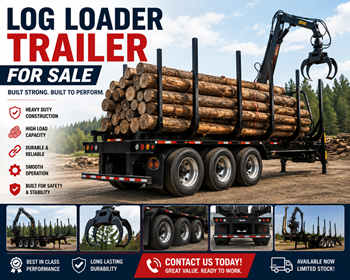
Effective timber loading depends heavily on operator judgment. Even well-maintained machinery requires careful positioning, controlled movement, and an understanding of working limits. A trailer log loader can support organized woodland operations when users develop consistent procedures for preparation, loading, transportation, and inspection.
Begin With a Pre-Operation Assessment
Before handling timber, operators should inspect both the machinery and the surrounding environment.
Check the working surface, visibility, overhead clearance, and access routes.
Look for nearby people, unstable timber piles, and obstacles that could interfere with lifting movements.
Confirm Equipment Readiness
Inspect visible structural components, hydraulic connections, controls, and lifting attachments.
Check that protective devices are in place and functioning.
Do not operate machinery with known safety-critical defects.
Review the manufacturer’s instructions whenever operating requirements are uncertain.
Understand Rated Lifting Limits
Safe loading requires more than knowing the approximate weight of a log.
Lifting capacity can vary with reach, operating position, and equipment configuration.
Use the Correct Load Information
Consult the manufacturer’s load chart for the intended lifting arrangement.
Account for the weight of lifting attachments where required.
Never assume a log can be lifted safely simply because the machinery handled a similar piece previously.
Wood density, moisture content, and dimensions can produce substantial weight differences.
Practice Smooth Control Movements
Abrupt lifting or rotation can cause suspended timber to swing.
Uncontrolled movement may affect equipment stability or bring material into contact with nearby objects.
Reduce Sudden Direction Changes
Operate controls progressively and allow sufficient time for the load to settle.
Keep lifting movements within the designated working area.
Avoid dragging logs in ways that exceed the equipment’s approved operating procedures.
Smooth operation supports precision and reduces unnecessary mechanical stress.
Maintain Clear Communication
Woodland operations sometimes involve several people working near the same collection area.
Everyone should understand their responsibilities before machinery starts.
Establish Exclusion Zones
No person should stand beneath suspended timber or within a hazardous lifting path.
Use clear communication methods when additional workers are involved.
If communication becomes uncertain, stop the operation until instructions are understood.
Never assume another person can see or anticipate machinery movement.
Improve Loading Consistency
Organized timber placement reduces repeated adjustments.
Position logs where they can be reached safely and loaded without unnecessary repositioning.
A trailer log loader performs more effectively when operators work through a planned loading sequence.
Balance the Load
Follow manufacturer instructions for timber placement and weight distribution.
Avoid concentrating excessive weight at one end or side.
Secure logs with suitable restraints before transportation.
Check that material remains within the designated load area.
Develop Good End-of-Shift Practices
Once loading activities finish, inspect equipment for visible damage.
Remove debris where safe and check for leakage or loose components.
Record unusual operating behavior for further assessment.
Support Long-Term Skill Development
Operator experience improves through appropriate training, supervised practice, and familiarity with equipment limitations.
New operators should begin with straightforward tasks under suitable supervision.
More demanding loading conditions require additional judgment and preparation.
A regional log handling information resource may also help when researching equipment-related considerations.
Conclusion
A trailer log loader becomes more effective when operators combine technical understanding with disciplined working habits. Pre-operation inspections, controlled lifting, clear communication, and balanced loading contribute to safer timber handling. Consistent procedures help reduce avoidable errors and create a more predictable woodland workflow, particularly when operating conditions change throughout the working day.